
History
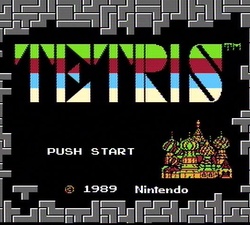
"Tetris" is that game about falling pieces: tetrominoes slide into a narrow well while you pray for the long bar to score a Tetris—four lines at once. On the NES (for many in Russia, the legendary Dendy), it sounded different: that satisfying cartridge thunk, the D-pad’s click, and Hirokazu Tanaka’s 8‑bit take on "Korobeiniki" you recognize in two notes. This is Nintendo’s Tetris—spare, stubborn, endlessly replayable—a puzzle that quietly teaches order and patience. Playground showdowns came down to level and speed, arguments over wonky blocks, and proudly scribbled high scores in school notebooks. Hit Start and the world narrows to pure rhythm: place, rotate, clear. Learn more about the phenomenon in the Wikipedia article.
Its road to 8‑bit canon was long and cinematic: from Muscovite Alexey Pajitnov’s idea to Nintendo’s official Tetris on the NES in 1989. This version rests on two timeless pillars—A‑Type and B‑Type: a line‑clear marathon and a garbage‑cleanup challenge; you pick level, speed, and starting stack height, catch the flow, and don’t let go. Music A/B/C, the familiar "Korobeiniki", that austere screen frame—and the infamous Level 29 kill screen where pieces drop near instantly. On the Dendy (a NES clone), Tetris became a shared language: “falling bricks,” the hunt for the long bar, the joy of four‑in‑a‑row, and evening showdowns around the TV. Classic NES Tetris still thrives at tournaments and at home; it’s a cultural touchstone. Want to dig through the whole history—releases, rights, legends—and see why your hand still reaches for the controller?
Gameplay

NES Tetris is adrenaline-soaked meditation. Boot it up and Korobeiniki—the Tetris theme—spreads underneath while tetrominoes pour into the well. Your thumb finds the groove on the D-pad: quick rotate, soft drop, a firm press down to speed it along—the piece seats flush, exactly where you meant. Your mind snaps to pure focus, true retro-arcade mode: you square the bricks, build a shelf for the I-piece, rip four lines at once and feel that inner click—the Tetris. A white flash wipes the rows, the music almost smiles, and for a heartbeat it’s quiet. Next beat—palms sweaty: the speed ramps, and one bad tap and the stack bites back. NES Tetris, the falling-block classic—call it what you like; the feeling’s the same: just you and a glassy well that has to stay clean.
The rhythm here is like breathing: a slow rise, quick exhale—and a tidy line clear. Eyes keep darting to NEXT, ears lock onto A-Type and B-Type, and your thumb preps a midair twist to tuck a Z or L into a razor-thin gap at the last second. A-Type is the endless flow with rising gravity; B-Type starts under a pileup—garbage underneath—so every clean line feels like a breath. This isn’t a how-to on Tetris rules; it’s about instinctive tactics: keep the well neat, don’t feed the staircase, save the long bar for a Tetris, and keep cool when the speed spikes. Then comes the clutch save, the well turns smooth again, the score climbs, and you slip into flow, tapping out the rhythm on the D-pad. We break down timing, tempo, and that feeling of control—short and to the point—in the gameplay section: no diagrams, just the feel of the game and the hunt for a high score. In the end, it’s calm after the storm and a warm fatigue: once again you’ve tamed your own chaos.