
Tetris Gameplay
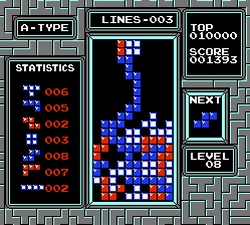
NES Tetris is that quintessential “Russian” Tetris a lot of folks remember as the one from the Dendy/Famicom days: the Korobeiniki earworm humming in your head, thumbs on the D-pad finding a groove, and the first well waiting for you to start stacking. It’s honest and barebones: tetrominoes fall like rain with no breathers, you catch, rotate, and place them, trying not to punch holes in your stack. And the higher the score climbs, the wilder the carnival: speed rises like lungs on a sprint, and every misdrop stings — you built in the wrong spot, kept the well too narrow, lost the tempo.
Rhythm and the well
The gameplay here is a constant conversation with gravity. Early on you’ve got seconds to aim: spin, slide, give a gentle soft drop when everything lines up just right. But the level climbs, lines clear faster, and you stop thinking — you react. The line piece becomes the headline of the day: you carve a well on the right or left for it, stash up patience for it, even sacrifice a couple of safe clears for it. When it finally stands tall and four rows flash at once — that’s the Tetris you came for. No frills, just clean satisfaction — the stack exhales, and you get a couple of breaths back.
But Nintendo’s Tetris isn’t a chill-out. It demands discipline. Leave your shaft too deep and you risk a tilt that turns into an avalanche of errors. Try rescuing side holes and you lose timing, piling up garbage. The game doesn’t forgive panicking at the wall: without modern wall kicks you won’t always turn in time, and the T-piece can wedge sideways like a fish in a net. In those moments, a quiet hush grows inside — the music keeps playing while you reset priorities: stop forcing tetrises, sober up the stack. One flattening move, one tidy double — and you can breathe again.
A-Type and B-Type
A-Type is an endless marathon where you’re both coach and rival. Pick a starting level, lock into your tempo, and dive in: clear lines, chase score, ride the speed curve. It feels like the screen has its own metronome: you catch your stride and as long as it doesn’t break, everything clicks. Cross a speed threshold and it turns into a pure reflex game. Every landing sounds like a drumstick hit, every clear a handclap, and a Tetris — a full-on chord.
B-Type has a different vibe. Garbage rows jut out from the start, gaps like crooked bricks in a yard. The goal is simple and clean: clear 25 lines. But that simplicity is sly: the starting height sets the mood of the run. Pick it high and whoosh — it’s surgery. Breathe, keep the well open, wait for the line piece, fit your zigzags and squares so you don’t seal your exit. When the counter clicks over on the last line, it’s a different kind of joy: like digging out a mess and finding smooth floor underneath.
The cost of one mistake
Tetris’s core tension is the balance between greed and caution. You crave one more Tetris, hands itching to leave a skinny chute, but experience whispers: level the field first. You tap down to hurry the landing, but too early and the piece noses into the wrong nook. You train yourself to feel the weight of each second: sometimes it’s better to let a block settle and find its groove than to rush it. That’s the charm — you don’t so much think as feel through your fingers where to snake the Z, when to twist the T, and how not to let the square push you around when there’s no room for it.
The game rewards patience generously. Pull the holes out and you watch the well brighten. Skip a sketchy wall trick and you dodge a snowball. Every decision hits on beat: the line blinks — boom, score climbs; nail four — heart jumps; drift into crooked stacking — your D-pad taps quicken, and there’s only one thought left: survive until the next line piece. These microstories last seconds, but they’re what make a run that feels so good when you glance at the high-score table afterward.
Music and tempo
The tunes aren’t just background — they hold you by the shoulders. Pick a track and Korobeiniki sets your stride: measured, springy, like wheels on rails. Funny thing is, the game’s true tempo is set not by music but by fall speed and your own pulse. On slow levels the melody feels roomy, you have time to “talk” to each block. At high speed you start hearing invisible accents — your hands hit the downbeats, and rotations snap in the right split-second. It’s pure motor memory, almost a dance — call it Dendy Tetris, NES Tetris, whatever; it always becomes a ritual of rhythm and reaction.
Within these rules there are no crutches or prompts. No hold slot, no safety net — just reflexes, smarts, and a cool head. That’s why every rescue means more. When you manage to swivel a T into a tight notch at crazy speed, you get that quiet flicker of pride. When a Tetris finally thunders after a string of doubles — it’s like dropping a boulder off your shoulders. That’s the essence of the classic: clean geometry under the pressure of time.
And yeah, the more you play, the clearer your little habits become: some always build the well on the right, others on the left; some guard space for the line piece religiously, others don’t mind a triple if it keeps the stack tidy. In that way Tetris feels like a great chess game — only with more moves per minute and fewer chances to fix a blunder. That’s why those crisp A-Type marathons and B-Type “operations” stick in your memory: they form your personal Tetris story — the one on a cartridge, on a Nintendo, where every second is a chance to play better.