
Tetris Walkthrought
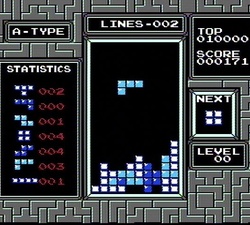
NES Tetris — the one most people just call classic Tetris — sounds simple: sit down and play. But if you want to beat the modes consistently and roll those rocket endings on cue, let’s break it into clear steps. Start clean: on the mode screen pick A-TYPE or B-TYPE and set your level with the D-pad. Pro tip: hold A and press Start to jump ten levels, so Nintendo Tetris gets you into real speed fast. From here on out it’s all signal, no fluff — how to play with confidence and finish strong.
A-TYPE: the marathon to 19
In A-TYPE the goal isn’t just survival — it’s a plan. From the very first pieces, leave a well for the I-piece on the far right (column 10) and keep your stack around 6–8 high to leave room to maneuver. Early levels are for chaining tetrises: big points, low stack. If a long-bar drought hits, don’t panic — cap the well with doubles and triples, but shape it so one I-piece later clears the mess in a single swoop. Solid template: a J/L stair-step on the left, a flat wall on the right, and a tiny lip by the well that a T or S/Z can tidy without drama.
Speed bumps up every ten lines. Watch your transitions: from 15–18, flatten waves, lower the stack, and stop gambling for one more tetris. Level 19 arrives in a snap — the infamous transition old-school NES Tetris vets whisper about. Prep is simple: hit it with a low field, open well, and no pockets glued to the right wall. The fewer liabilities, the easier those first 19 seconds feel.
Level 19 is different. Forget greed: singles are fine if they stabilize the board. Don’t hoard the I for a rainy day — see a clean tetris, take it. Horizontal movement here is tap-tap-tap; don’t hold forever or DAS will fling pieces too far. Learn to rotate both ways: the “wrong” spin can fit where the “right” one can’t. Spot a nasty gap by the wall? Seal it immediately. Don’t leave pits deeper than two — on 19 they’re practically unfixable.
Level 29 is basically a kill screen: pieces drop with no grooming time, and classic Tetris becomes a pure reaction test. The one trick is to arrive with a glass-flat field and an open well so a few lightning I-pieces give you dessert tetrises. After that — it’s how long you can hang on. The score caps at 999,999; if you’re hunting a maxout, plan your heavy tetrises — they’re most valuable around 18–19 when the level multiplier pays out.
B-TYPE: 25 lines and a rocket
B-TYPE isn’t a run from zero — it’s a tight objective: clear 25 lines with a chosen garbage height. The “beat Tetris” path is cleaner here: the finish line is close and mistakes are pricey. Start with 9-0 to learn the rhythm, then crank the height. Priority one: drill a tunnel to your well. In the opening seconds, play small — singles and doubles, anything to breathe. Once the well is open and the ceiling pressure’s gone, flip to tetrises and count the remaining lines so you don’t overshoot the finish with stray singles.
The classic challenge is 9-5: tall garbage, brisk pace, and that sweet rocket ending. Game plan: at the start don’t fight the stack — patch holes and carve a safe shaft; skip tetrises until the top two or three rows are nice and flat. Once you’ve got a runway, keep the well open and the stack below mid-screen. Close out with tetrises if you can, but don’t get heroic: better to finish with a tidy double than top out from greed on the last few lines.
Want “real” speed without the long warmup? Raise the start: hold A + Start in B-TYPE to jump straight to 19. Same rules as the marathon — zero clutter, short side taps, both rotation directions ready. Over 25 lines the board can reconfigure multiple times — don’t cling to the first plan, pivot as needed. The mission is the launch sequence, and clean play gets you there fast.
Micro-moments that decide games
Right before a piece locks, it’s still alive — a single last-frame rotate can save a doomed column. It shows best on J/L: a “wrong-way” spin can hook onto a ledge. S/Z love sliding down a slope: build a one-cell step and they’ll settle without holes. The T-piece is perfect for sealing three-wide pockets — memorize that pattern for when an I-piece won’t bail you out. And remember: on 19 you barely need soft drop — the game is fast enough; pressing down often steals precious milliseconds.
A couple housekeeping tricks. If the stack turns ugly, lower it: two or three singles reset control. Don’t move the well if you can help it, but if you must, do it low, after the center is flat, and close the old pockets behind you. A flat board equals freedom; freedom equals tetrises; tetrises mean points and a calm road to the finish, whether that’s NES Tetris A-TYPE or 25 lines in B-TYPE.
And yeah, the music doesn’t clear lines, but it sets your tempo. Pick a theme and don’t fidget — at high levels, menu dawdling costs runs. For a button/mode cheat sheet, swing by /gameplay/, and if you want the origin story of falling tetrominoes and why everyone calls it Tetris on every block, head to /history/. After that it’s just the field, the pieces, and that rocket we’ve been chasing since the cartridge that simply said Tetris.